Supposedly, “climate science is baaaack.” The DOE has published a new climate assessment report that conflates “nuance” with delaying climate action. It exaggerates scientific uncertainty, overstates the benefits of CO₂, and emphasizes the risks of climate action while downplaying the risks and costs of inaction. Here is a direct quote:
“Mainstream climate economics has recognized that CO₂-induced warming might have some negative economic effects, but they are too small to justify aggressive abatement policy and that trying to ‘stop’ or cap global warming even at levels well above the Paris target would be worse than doing nothing.”
So, what are those targets, and how are we doing?
The Paris Agreement is a legally binding international treaty on climate change, adopted in 2015 by 196 parties, including the United States—which has now exited the agreement twice. Its main goal is to limit global warming to well below 2°C, preferably to 1.5°C, compared to “pre‑industrial” levels. The agreement also calls for adaptation to climate change.
It sounds clear enough—except for one big question: what exactly were pre‑industrial temperatures?
The Pre-Industrial Mystery
Strangely, despite how central that number is, the Paris Agreement never pinned it down. There is no official baseline, no agreed‑on thermometer reading from the past. And that leaves a serious problem: how can we know how close we are to the target if we do not know where we started?
To get some clarity, I did what the agreement did not: translate the abstract 1.5°C and 2.0°C goals into actual global average temperatures, using the best available data.
Why “Anomalies” Instead of Temperatures?
When scientists report global temperatures, they usually do not give you the actual average temperature in °C. Instead, they report anomalies—the difference from a reference period, usually a few decades with good thermometer coverage.
Why? Because thermometers are finicky. A few feet of elevation, a patch of urban pavement, or a nearby tree line can throw off the reading. Working with anomalies lets scientists track changes more accurately, without being skewed by where a thermometer happens to sit.
This method has been excellent for spotting long‑term trends. But recently, climate science has given us a way to track real temperatures directly.
ERA5
Thanks to climate reanalysis—a blend of weather observations and computer models—we can now estimate daily average surface air temperatures worldwide. ERA5, from the European Centre for Medium‑Range Weather Forecasts, is among the most respected reanalyses.
I use ERA5’s 2-meter surface air temperature (the air temperature about 6 feet above ground) and smooth seasonal ups and downs with a one‑year running average. The result: a reliable estimate of real global temperature.
Before Fossil Fuels
To find the “pre‑industrial” temperature the Paris Agreement implies, I used the PAGES2k reconstruction. This global project combines climate proxies—tree rings, ice cores, and sediments—to estimate global temperatures year by year back to the year 1.
PAGES2k reports anomalies relative to 1961–1990. To get real °C values, I anchored PAGES2k to ERA5 by matching their average values over the overlapping years (1941–2017). The adjustment required was +13.822°C.
Here is the result for recent times.

The Pre-Industrial Baseline
Defining “pre‑industrial” is imprecise, but I followed a common approach: use everything before large‑scale fossil fuel burning began. I set the cutoff at 1764.
Many reports use 1850–1900 as a proxy for “pre‑industrial,” mainly because that’s when thermometer records become reliable. But by the mid‑1800s, the Industrial Revolution was underway, and greenhouse gas concentrations had already risen. In other words, 1850–1900 was already warmer than true pre‑industrial conditions.
Averaging the reconstructed temperatures for the 1,000 years before 1764 (764–1763) gives a global 2‑meter temperature of about 13.5°C. See below.

This lets us translate the Paris targets into real temperatures:
• 1.5°C above pre‑industrial → 15.0°C
• 2.0°C above pre‑industrial → 15.5°C
How Close Are We?
Earth’s temperature naturally swings by ~3.9°C seasonally. That means the 1.5°C Paris goal (15.0°C annual average) corresponds to a daily range from ~13.0°C in early January to ~16.9°C in late June.

Comparing these to ERA5:
• 2024: Averaged ~0.1°C above the 1.5°C target.
• 2025 (to date): Averaging ~0.03°C below the 1.5°C target—slightly better, but still hovering near the threshold.
We have essentially reached the 1.5°C goal in real temperatures.
Energy Imbalance and Future Warming
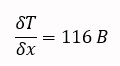
Earth is still absorbing more solar energy than it emits to space. To reach energy balance, global temperature must rise toward:

where ASR is absorbed solar radiation, ETR is emitted thermal radiation, and T is current absolute temperature.
In 2025, the fourth root of the ASR/ETR ratio is ~1.0015, implying a future equilibrium of:

Given current trends, 15.5°C (2°C above pre‑industrial) may be unavoidable by ~2033.
Summary: Should We Use Real Temperatures Instead of Anomalies?
By translating the Paris Agreement limits into real temperatures (15.0°C and 15.5°C) we gain a clearer, more intuitive benchmark. Based on ERA5 and PAGES2k, true pre‑industrial global temperature was ~13.5°C.
Using real temperatures:
• 2024 exceeded the 1.5°C target.
• 2025 is hovering near it.
Global temperature naturally swings by 3.9°C annually, so a fixed target must be interpreted with that in mind.
Conclusion
Expressing climate goals in real temperatures makes them easier to communicate and compare with datasets like ERA5. By this measure, we are right on the edge of failing Paris goals.
The DOE report implies that exceeding these targets—even well above them—will not be too harmful and that trying to prevent it would be too costly. It uses scientific uncertainty as a reason to delay action.
Where I see the real uncertainty is in the report’s conclusions.



 hswildman